
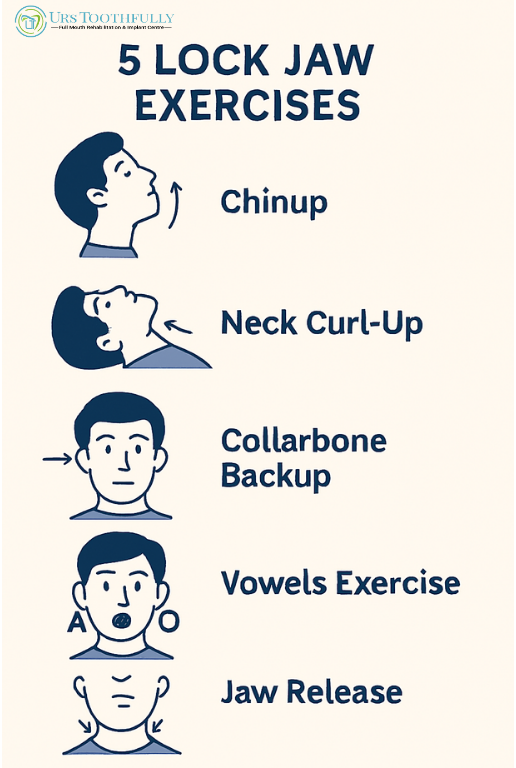
Quick answer: Lock jaw, meaning stiffness, clicking, or restricted movement in the jaw joint, can often be eased with five targeted exercises: the chin-up, neck curl-up, collarbone backup, vowel exercise, and jaw release. Each should be done slowly, in 2-3 sets, without pain. If jaw locking is caused by TMJ disorder, these exercises should only begin after the joint is assessed and stabilised by a dentist or TMJ specialist. Doing them too early can make TMJ symptoms worse.
If you’re in Kolkata and dealing with jaw pain, clicking, or a jaw that locks when you open wide, a TMJ specialist can assess whether exercises are safe for your case, or whether you need an occlusal splint first.
What Causes Lock Jaw?
Lock jaw usually comes from tightness or dysfunction in the muscles and ligaments around the temporomandibular joint (TMJ), the hinge connecting your jawbone to your skull. Common triggers include teeth grinding (bruxism), clenching from stress, poor posture, jaw injury, or an untreated TMJ disorder. Left alone, it tends to show up as clicking, popping, a jaw that catches when you yawn, or pain that spreads to the neck and ears.
Important distinction: if your jaw locks fully (you can’t open or close it) or the pain is sharp and sudden, that’s a dental emergency. Call a dentist immediately rather than starting exercises.
Should You Exercise a Locked Jaw, or Rest It First?
This is the one point most jaw-exercise content online gets backwards, so it’s worth stating clearly: if you have diagnosed TMJ disorder (TMD), exercising the jaw before the joint is corrected can worsen the problem. The right sequence is:
- Rest and immobilise. Talk less, eat softer foods, avoid wide yawns.
- Correct the joint, usually with an occlusal splint fitted by a dentist, to bring the jaw into a stable position.
- Then strengthen, using jawline exercises and myofunctional therapy (MFT) to hold that corrected position.
If you skip straight to strengthening exercises while the underlying TMJ misalignment is still there, you’re often just reinforcing the wrong posture, which is why some people report their locked jaw feeling worse after starting a jawline exercise routine they found online.
5 Jawline Exercises to Relieve Lock Jaw
Do these slowly and with control. Stop immediately if you feel sharp pain. Mild stretching discomfort is normal, pain is not.
1. Chin-Up
Close your mouth, tilt your head back slightly, and gently lift your lower lip while tightening your chin and jawline muscles. You should feel a stretch along the chin and jaw. Hold for 10 to 15 seconds, release, and repeat 15 times across 3 sets, with a 10-second break between sets.
2. Neck Curl-Up
Lie down, press your tongue to the roof of your mouth, and slowly lift your neck a small amount, like a gentle neck crunch. Move up and down in a controlled way, resting a few seconds between reps. This activates the neck muscles that support jaw stability.
3. Collarbone Backup
Sit comfortably. Pull your shoulders back until you feel your neck muscles engage, keeping your chest lifted. Hold for 2 seconds, then come forward gently while keeping your chin parallel to the floor. Repeat for 3 sets of 15.
4. Vowels Exercise
Open your mouth and exaggerate the vowel sounds, starting with a wide “O” shape, then moving through the others. This works the muscles around the jaw and mouth without straining the joint itself. It looks simple, but it’s genuinely effective for loosening tight jaw muscles.
5. Jaw Release
Sit up straight. Swallow deliberately a few times, then open your mouth in a slow, coordinated count. Close your mouth while making a gentle chewing motion, focused on your breathing. Take a slow, deep breath in, hold for 10 seconds, and release slowly. Repeat 10 to 15 times.
How often: Once daily is enough to start. Most people notice looser jaw movement within 2-3 weeks of consistent practice. This isn’t an overnight fix, and forcing it faster (doing all sets aggressively on day one) is how people strain the joint.
Jawline Exercises vs. Jawline “Hacks” (Chewing Gum, Jaw Trainers)
If you’ve searched for jawline definition rather than jaw pain relief specifically, here’s the honest answer: chewing gum and plastic jaw-training tools mostly work the masseter (cheek) muscle in isolation, and won’t correct an underlying TMJ issue. In some cases, aggressive gum-chewing can actually aggravate jaw clenching and worsen TMJ symptoms. The five exercises above are safer because they work the jaw and the supporting neck muscles together, which is what actually stabilises the joint.
Frequently Asked Questions
Is it safe to do jaw exercises every day?
Yes, once a day is generally safe for most people once any underlying TMJ issue has been addressed. Overdoing sets or forcing range of motion too soon is the main risk.
How long before I see results?
Most people notice reduced stiffness and clicking within 2-3 weeks of consistent daily practice. Full improvement in jawline definition takes longer and depends on individual muscle tone and posture.
Can jaw exercises fix locked jaw caused by TMJ disorder on their own?
Not on their own. If the lock jaw is from TMJ disorder, exercises work best after an occlusal splint or dentist-guided correction, not as a substitute for it.
What’s the difference between jaw exercises for jawline definition and jaw exercises for lock jaw relief?
They overlap heavily. The same exercises listed above build muscle tone (aesthetic benefit) while easing joint stiffness (relief benefit). The main difference is sequencing: if you’re chasing jawline definition with no jaw pain, you can start straight away; if you have pain, clicking, or locking, see a dentist first.
When should I see a dentist instead of doing exercises at home?
If your jaw locks completely, if pain is sharp or sudden, if clicking is accompanied by ear pain or headaches, or if symptoms don’t improve after 3-4 weeks of consistent exercise, book a TMJ assessment.
Book a TMJ Assessment with Ur’s Toothfully Full Mouth Rehabilitation and Dental Implant Centre
Dr. Chetna Tikmani, TMJ Specialist at Ur’s Toothfully Full Mouth Rehabilitation and Dental Implant Centre, recommends a professional assessment before starting any jaw exercise routine if you have persistent clicking, pain, or locking, rather than after trying exercises for weeks with no relief.
Whichever part of Kolkata you’re in, there’s a clinic nearby: Park Street for the central and Esplanade area, Salt Lake for Bidhannagar and the eastern suburbs, and New Alipore for South Kolkata. All three are run as flagship centres with the same TMJ care standards, so you can book wherever’s easiest to reach.